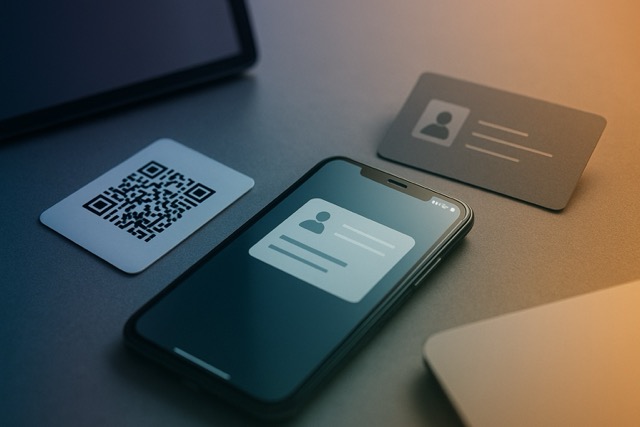
The right way to share contact information depends on the moment. A QR code works well across a table; a link is easier inside a text message; a printed number is useful when reception is poor. Choose a method that fits the person in front of you.
You do not need a different online identity for each method. A public digital profile can be the destination behind your QR code, your email signature and the link you send after a meeting.
Compare the methods by what the recipient needs
| Method | Useful when | Tradeoff |
|---|---|---|
| Profile link | You are texting, emailing or chatting online. | The recipient still needs to open it and choose an action. |
| QR code | Someone can scan a card, sign or another screen. | The code must be readable; a web profile needs a connection. |
| vCard file | The recipient wants your details in Contacts. | They must import it; saved copies do not update automatically. |
| Printed card | A quick handoff or an offline fallback matters. | Printed information can become outdated and may need typing. |
| NFC tag or card | You already use compatible tap-to-open hardware. | Requires that hardware and a compatible recipient device. |
These methods are complementary. A QR code is an entry point, a profile is a destination, and a vCard is a saved copy of contact details. Comparing them as if only one can win misses the workflow.
For an in-person introduction: QR plus a readable fallback
Put your QR on a business card or show it on your phone. Add an instruction such as “Scan to save my contact.” Keep a readable number or email alongside it, and give the recipient a moment to open the profile.
If the scan does not work, send the link or hand over the card. Repeatedly troubleshooting a phone is rarely the best use of a short conversation. The no-app sharing guide walks through the handoff.
For messages and email: use a clickable link
A short message carries more context than an unexplained QR image: “Good to meet you at the supplier event. Here are my contact details and the project we discussed.” Put the profile link after that sentence.
In an email signature, make the profile name clickable. An optional QR can help someone reading on a different screen, but it should not be the only route. People using one phone should be able to tap straight through.
For repeat business: make saving the contact easy
A customer who may need you in six months benefits from a recognizable contact in their address book. QRown's Save contact action downloads a vCard assembled from your profile details. The customer imports it using their phone.
Give the saved contact your business identity, not an unexplained personal nickname. A vCard with useful context makes more sense for this job than a screenshot of a phone number.
For NFC: check the hardware you already have
An NFC tag programmed with a web address can open a profile link on a compatible phone. If you use this approach, verify the tag provider's setup and test the actual card. QRown supplies the profile destination; this is not a claim that it supplies or programs NFC hardware.
A printed QR and readable link give people another route if tapping does not work. Buy or add hardware only if it helps your usual interactions.
Build a small, dependable sharing kit
- One current profile with your main contact details.
- A QR ready to display or print.
- A short message with the profile link and room for a personal reminder.
- A contact file you have tested on a phone.
- A readable fallback for offline situations.
Review which method people comfortably complete. Recorded scans or downloads can inform that review, but a completed conversation and a usable follow-up route are the practical goal.